
Updated August 7, 2026
What is AI Red Teaming?
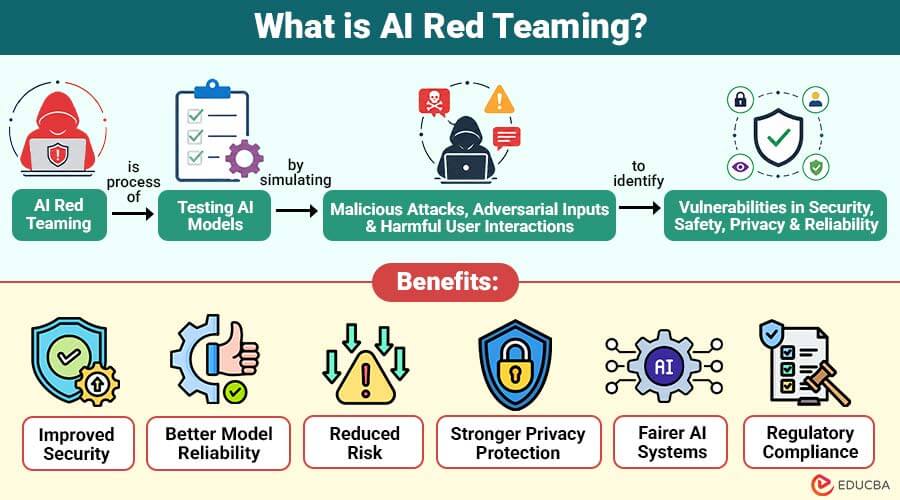
AI red teaming is process of testing AI models by simulating malicious attacks, adversarial inputs, and harmful user interactions to identify vulnerabilities in security, safety, privacy, and reliability.
Unlike traditional software testing, it evaluates how AI responds to deceptive prompts, jailbreak attempts, prompt injection, manipulated data, and other real-world threats. Its primary goal is to identify and fix vulnerabilities before they can be exploited.
For example, a company deploying a customer support chatbot may conduct AI red teaming by attempting to prompt the chatbot to reveal confidential customer information, generate offensive content, or bypass built-in safety restrictions.
Table of Contents:
Key Takeaways:
- AI red teaming identifies vulnerabilities in security, safety, privacy, and reliability before AI systems reach production environments.
- Continuous testing effectively strengthens AI resilience against evolving attacks, harmful outputs, and prompt manipulation techniques.
- Red teaming improves regulatory compliance, governance, fairness, and user trust through systematic AI vulnerability assessments.
- Organizations should regularly retest AI models after updates to maintain consistently secure and reliable performance.
Why is AI Red Teaming Important?
Modern AI systems interact directly with users, process sensitive information, and often make important decisions. Without proper testing, these systems can expose organizations to financial, legal, operational, and reputational risks.
AI red teaming helps organizations:
1. Identify Hidden Security Vulnerabilities
Uncovers hidden weaknesses before attackers exploit them, improving the overall security of AI systems.
2. Detect Harmful or Biased Model Behavior
Identifies biased, harmful, or inappropriate responses to ensure fair and responsible AI behavior consistently.
3. Prevent Prompt Injection Attacks
Detects prompt-injection vulnerabilities that could manipulate AI outputs or effectively bypass built-in safety controls.
4. Improve Model Reliability
Enhances AI reliability by ensuring accurate, consistent, and dependable responses across diverse real-world scenarios consistently.
5. Protect Sensitive Information
Prevents accidental exposure of confidential, personal, and business information during AI interactions with users securely.
6. Strengthen AI Governance
Supports responsible AI governance through improved oversight, risk management, policy enforcement, and accountability across organizations.
7. Meet Regulatory and Compliance Requirements
Helps organizations comply with evolving AI regulations, industry standards, and legal requirements for trustworthy deployment.
How Does AI Red Teaming Work?
AI Red Teaming follows a structured testing process to evaluate AI systems under realistic attack scenarios.
1. Define Testing Objectives
The first step is identifying what needs to be tested. Objectives may include:
- Model security
- Privacy protection
- Safety guardrails
- Bias detection
- Regulatory compliance
- Prompt injection resistance
- Data leakage prevention
Clear objectives help focus testing efforts.
2. Identify Potential Threats
The red team identifies possible attack scenarios, such as:
- Jailbreak prompts
- Prompt injection
- Social engineering
- Adversarial inputs
- Malicious code generation
- Sensitive data extraction
- Toxic content generation
- Misinformation requests
Threat modeling ensures realistic testing.
3. Simulate Attacks
Testers interact with the AI system using carefully designed prompts and attack techniques.
Examples include:
- Trying to bypass safety filters
- Requesting confidential information
- Providing misleading instructions
- Injecting hidden prompts
- Uploading manipulated files
- Creating ambiguous questions
- Testing multi-step attacks
The objective is to expose weaknesses that ordinary testing might miss.
4. Analyze Model Responses
Each response is evaluated for issues such as:
- Harmful outputs
- Hallucinations
- Biased responses
- Privacy violations
- Security failures
- Incorrect reasoning
- Unsafe recommendations
The findings are documented for further analysis.
5. Fix Identified Vulnerabilities
Developers improve the AI system by:
- Updating safety policies
- Strengthening prompt filters
- Improving retrieval systems
- Retraining models
- Adjusting model parameters
- Adding input validation
- Enhancing monitoring
This reduces future risks.
6. Retest the System
After implementing improvements, the AI system is tested again to verify that vulnerabilities have been resolved without introducing new issues. Continuous testing keeps AI systems resilient as threats evolve.
Common AI Red Teaming Techniques
Organizations use various testing techniques to identify vulnerabilities and evaluate the security, safety, and reliability of AI systems.
1. Prompt Injection Testing
Attempts to manipulate the AI by inserting hidden or misleading instructions that override its intended behavior.
2. Jailbreak Testing
Tests whether users can bypass built-in safety restrictions to prompt the AI to generate prohibited or harmful content.
3. Adversarial Testing
Uses carefully crafted inputs designed to confuse the AI, causing incorrect predictions or unexpected responses.
4. Bias Testing
Evaluates whether the AI produces unfair, biased, or discriminatory outputs for different individuals or groups.
5. Privacy Testing
Checks whether the AI unintentionally exposes confidential, personal, or sensitive business information.
6. Hallucination Testing
Measures how often the AI generates false, fabricated, or misleading information while appearing confident.
7. Toxicity Testing
Tests whether the AI produces offensive, abusive, hateful, or otherwise harmful responses under different scenarios.
Benefits of AI Red Teaming
AI Red Teaming offers several benefits that help organizations build secure, reliable, fair, and compliant AI systems while reducing potential risks.
1. Improved Security
Identifies vulnerabilities early, helping organizations prevent attacks and strengthen defenses for AI systems.
2. Better Model Reliability
Ensures AI delivers accurate, consistent, and dependable responses across a wide range of scenarios.
3. Reduced Risk
Minimizes security, legal, financial, and operational risks associated with deploying AI applications.
4. Stronger Privacy Protection
Helps prevent the accidental exposure of confidential, personal, or sensitive business information.
5. Fairer AI Systems
Detects bias and supports the development of fairer and more inclusive AI models.
6. Regulatory Compliance
Supports compliance with evolving AI regulations, governance frameworks, and security standards.
Challenges of AI Red Teaming
Although highly valuable, AI red teaming presents several challenges.
1. Rapidly Evolving Threats
New attack techniques and adversarial methods emerge regularly, requiring continuous testing and updates.
2. Complex AI Behavior
Large language models can generate unpredictable responses, making comprehensive evaluation more challenging.
3. Resource Intensive
Effective AI red teaming requires experienced security professionals, AI experts, and specialized testing resources.
4. No Complete Coverage
It is impossible to test every possible prompt, attack scenario, or user interaction.
5. Measuring Success
Evaluating AI responses can be subjective, making it difficult to define clear success criteria.
6. Constant Model Updates
Frequent AI model updates require repeated testing to ensure new changes do not introduce vulnerabilities.
Applications of AI Red Teaming
AI red teaming is widely used across industries to identify vulnerabilities, improve security, and ensure AI systems operate safely and reliably.
1. Healthcare
Tests medical AI systems for patient privacy, accurate diagnoses, and safe clinical recommendations.
2. Banking and Finance
Protects AI-powered fraud detection, customer support, and financial advisory applications from security threats.
3. Government
Evaluates AI used in public services, cybersecurity, defense, and national security applications.
4. E-commerce
Tests recommendation engines, virtual assistants, and customer support chatbots against manipulation and misuse.
5. Education
Ensures AI learning assistants deliver accurate, safe, and unbiased educational content for students and educators.
6. Manufacturing
Evaluates AI systems used for predictive maintenance, quality control, and production process optimization.
Final Thoughts
AI red teaming helps organizations build secure, reliable, and trustworthy AI systems by identifying vulnerabilities before deployment. Continuous testing improves safety, protects sensitive data, reduces security risks, supports regulatory compliance, and strengthens AI performance. Integrating red teaming into AI development ensures resilient, responsible, and dependable AI applications for long-term success.
Frequently Asked Questions (FAQs)
Q1. Who should perform AI red teaming?
Answer: AI red teaming is typically conducted by AI security specialists, cybersecurity professionals, machine learning engineers, and domain experts who understand potential attack techniques and the behavior of AI systems.
Q2. When should AI red teaming be performed?
Answer: AI red teaming should be conducted before deployment, after major model updates, when integrating new data sources, and periodically throughout the AI system’s lifecycle.
Q3. Does AI red teaming guarantee complete AI security?
Answer: No. AI Red Teaming significantly improves security but cannot eliminate every possible vulnerability. Continuous monitoring, regular testing, and timely updates are essential for maintaining AI safety.
Q4. How often should organizations conduct AI red teaming?
Answer: The frequency depends on the application’s risk level, but organizations should perform testing before releases, after significant model changes, and on a regular schedule to address emerging threats.
Recommended Articles
We hope that this EDUCBA information on “AI Red Teaming” was beneficial to you. You can view EDUCBA’s recommended articles for more information.


