
Updated July 29, 2026
What is Commercial Analytics?
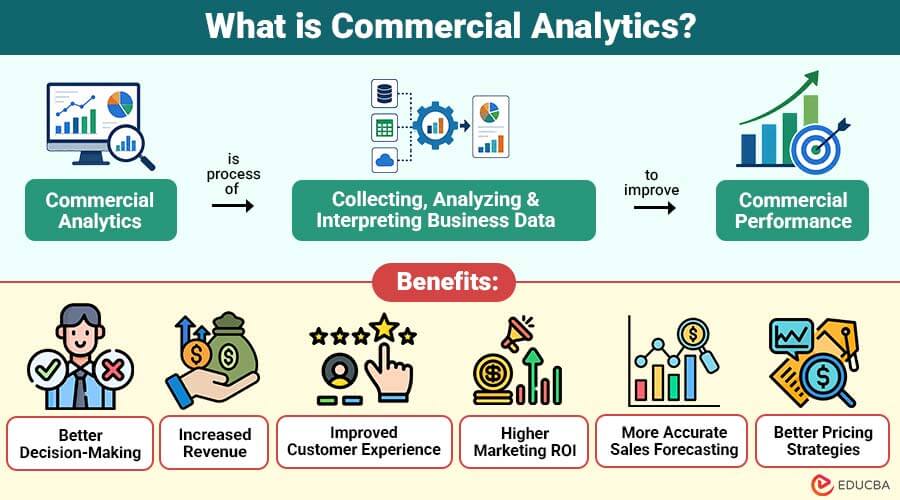
Commercial analytics is the process of collecting, analyzing, and interpreting business data to improve commercial performance. It combines information from sales, marketing, customer service, pricing, and market research to help organizations make informed business decisions.
Businesses utilize commercial analytics to comprehend what is occurring, why it is happening, and what should be done instead of depending on presumptions or prior experiences. These insights enable companies to improve revenue generation, strengthen customer relationships, and maximize profitability.
Commercial analytics is widely used across industries such as retail, healthcare, manufacturing, financial services, pharmaceuticals, telecommunications, and e-commerce.
Table of Contents:
Key Takeaways:
- Commercial analytics transforms business data into actionable insights that improve decision-making, sales performance, and profitability.
- It combines sales, marketing, customer, pricing, and market data for comprehensive business performance analysis.
- Predictive and prescriptive analytics help businesses forecast demand and optimize commercial strategies for sustainable growth.
- High-quality data, skilled professionals, and modern tools enable successful commercial analytics implementation across industries.
Why is Commercial Analytics Important?
Modern businesses function in rapidly changing markets where customer preferences, competition, and economic conditions constantly evolve. Commercial analytics provides reliable insights that help organizations respond quickly to these changes.
Its importance includes the following:
1. Supporting Data-Driven Business Decisions
By converting company data into useful insights, commercial analytics enables leaders to make well-informed decisions based on factual data rather than conjecture.
2. Identifying Profitable Customer Segments
It identifies high-value customer groups by analyzing purchasing behavior, allowing businesses to target marketing efforts more effectively and efficiently.
3. Improving Sales Effectiveness
Sales teams use analytics to understand customer needs, prioritize opportunities, improve engagement, and increase overall conversion rates successfully.
4. Optimizing Pricing Strategies
Analytics evaluates market trends, customer demand, and competitor pricing to establish profitable pricing strategies that maximize business revenue.
5. Enhancing Marketing Performance
Commercial analytics measures campaign results, identifies successful channels, and improves marketing strategies to achieve better customer engagement consistently.
6. Forecasting Future Demand
By analyzing historical trends and market patterns, analytics predicts future demand, enabling businesses to plan resources more effectively.
Key Components of Commercial Analytics
Commercial analytics includes several interconnected areas that provide valuable business insights.
1. Sales Analytics
Sales analytics measures performance, tracks revenue trends, identifies successful products, evaluates teams, and improves the effectiveness of overall sales decision-making.
2. Customer Analytics
Customer analytics examines customer behavior, preferences, purchasing patterns, and lifetime value to improve retention, satisfaction, and the delivery of personalized experiences.
3. Marketing Analytics
Marketing analytics evaluates campaign performance, measures engagement, tracks conversions, and consistently optimizes marketing investments to drive business growth.
4. Pricing Analytics
Pricing analytics examines customer demand, competitors’ pricing, discounts, and profit margins to maximize revenue while maintaining competitiveness.
5. Market Analytics
Market analytics studies industry trends, customer demand, competitor activities, and growth opportunities to support informed strategic business decisions.
Benefits of Commercial Analytics
Implementing commercial analytics provides numerous benefits.
1. Better Decision-Making
Business leaders use reliable data insights to make informed decisions, reduce uncertainty, and improve overall business performance effectively.
2. Increased Revenue
Commercial analytics identifies profitable opportunities, valuable customers, and successful products, helping businesses increase sales and maximize revenue.
3. Improved Customer Experience
Businesses consistently understand customer preferences, deliver personalized experiences, improve satisfaction, strengthen relationships, and encourage long-term customer loyalty.
4. Higher Marketing ROI
Marketing teams optimize campaigns, reduce unnecessary spending, improve targeting, and achieve higher returns on marketing investments.
5. More Accurate Sales Forecasting
Historical data and predictive analytics improve sales forecasts, helping businesses plan resources, budgets, and future growth confidently.
6. Better Pricing Strategies
Businesses optimize pricing using customer demand, market trends, and competitor insights to improve profitability and sales performance.
How Does Commercial Analytics Work?
Commercial analytics follows a structured process for transforming raw data into valuable business insights.
Step 1: Data Collection
Organizations gather data from multiple sources, including:
- CRM systems
- ERP software
- Sales databases
- Marketing platforms
- Customer surveys
- Social media
- Website analytics
- Financial systems
Step 2: Data Integration
The collected data is combined into a centralized platform to provide a complete business view.
Step 3: Data Cleaning
Errors, duplicate records, and incomplete information are removed to improve data quality.
Step 4: Data Analysis
Analytical techniques are applied to identify patterns, trends, and business opportunities.
Step 5: Reporting
Interactive dashboards, charts, and reports present insights in an easy-to-understand format.
Step 6: Decision-Making
Business leaders use these insights to improve strategies, operations, and customer engagement.
Common Commercial Analytics Techniques
Businesses use various analytical methods depending on their goals.
1. Descriptive Analytics
Analyzes historical business data to summarize past performance, identify trends, and support informed decision-making across departments effectively.
2. Diagnostic Analytics
Examines business data to identify root causes behind outcomes, helping organizations understand performance changes and operational challenges.
3. Predictive Analytics
Forecasts future trends, consumer behavior, and business results using machine learning, statistical models, and historical data.
4. Prescriptive Analytics
Recommends data-driven actions that optimize business decisions, improve outcomes, and maximize operational efficiency and profitability consistently.
Applications of Commercial Analytics
Commercial analytics supports many business functions.
1. Sales Optimization
Organizations identify high-performing sales channels, improve lead conversion rates, and reduce sales cycle times.
2. Customer Segmentation
Customers are grouped based on demographics, purchasing behavior, interests, or spending patterns for targeted marketing.
3. Product Performance Analysis
Businesses evaluate which products perform well and identify underperforming products that require improvement.
4. Demand Forecasting
Companies predict future demand to improve inventory management and production planning.
5. Profitability Analysis
Commercial analytics identifies products, services, customers, or regions generating the highest profits.
Challenges of Commercial Analytics
Despite its benefits, organizations often encounter implementation challenges.
1. Poor Data Quality
Incomplete, outdated, or inaccurate data reduces the accuracy of analysis, leading to unreliable insights and poor business decision-making.
2. Data Silos
Data stored across separate departments limits collaboration, reduces visibility, and makes comprehensive business analysis more difficult overall.
3. Complex Data Integration
Combining data from multiple systems requires specialized tools, technical expertise, significant time, and careful planning for success.
4. Privacy and Security Concerns
Businesses must protect sensitive customer data, prevent breaches, and comply with evolving privacy regulations and industry standards.
5. Skill Shortages
Organizations require skilled analytics professionals to interpret data, build models, create reports, and support informed business decisions.
6. Rapidly Changing Markets
Changing customer preferences and market conditions require businesses to update analytical models and strategies regularly for accuracy.
Final Thoughts
Commercial analytics enables businesses to transform data into valuable insights, improve sales, optimize pricing, enhance customer experiences, and support strategic decisions. By investing in quality data, advanced analytics technologies, and skilled professionals, organizations can reduce risks, identify growth opportunities, and achieve sustainable long-term business success.
Frequently Asked Questions (FAQs)
Q1. How often should commercial analytics reports be updated?
Answer: The reporting frequency depends on business needs. Some organizations monitor dashboards in real time, while others generate daily, weekly, monthly, or quarterly reports for performance tracking and strategic planning.
Q2. What skills are needed to work in commercial analytics?
Answer: Professionals typically need skills in data analysis, statistics, business intelligence tools, Excel, SQL, data visualization, communication, and problem-solving. Knowledge of platforms like Power BI, Tableau, or Python is also beneficial.
Q3. How does commercial analytics support product launch decisions?
Answer: Commercial analytics evaluates customer demand, competitor activity, pricing trends, and market opportunities, helping businesses launch products with greater confidence and improve their chances of success in the market.
Q4. Can small businesses use commercial analytics?
Answer: Yes. Small businesses can use commercial analytics to monitor sales, understand customer behavior, evaluate marketing campaigns, and make better business decisions. Many affordable cloud-based analytics tools make implementation accessible for businesses of all sizes.
Recommended Articles
We hope that this EDUCBA information on “Commercial Analytics” was beneficial to you. You can view EDUCBA’s recommended articles for more information.


