


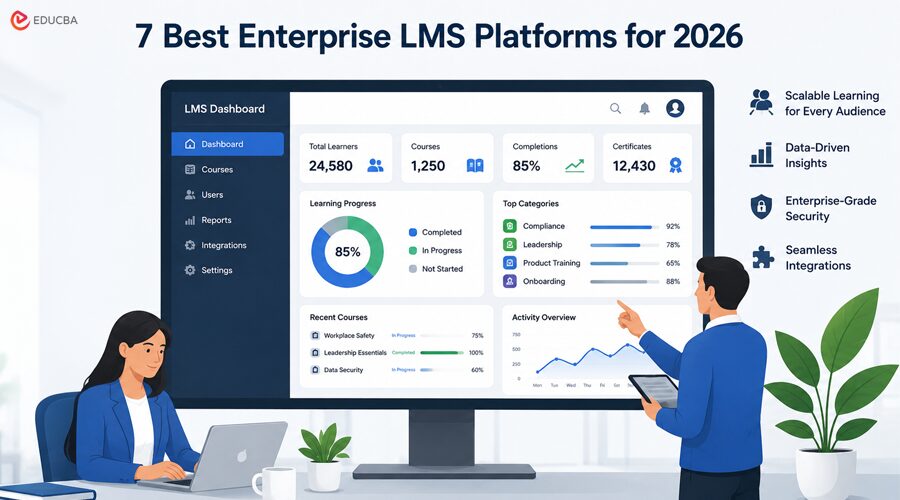
Choosing the right Enterprise LMS Platforms is essential for organizations looking to improve employee training, customer education, compliance, and skills development at scale. Modern enterprise LMS solutions go beyond course delivery by offering AI-powered personalization, advanced analytics, seamless integrations, and enterprise-grade security to support diverse learning needs.
With numerous options available, selecting the best platform depends on your organization’s size, learning objectives, budget, and technical requirements. This guide compares the 7 best Enterprise LMS Platforms for 2026, highlighting their key features, strengths, limitations, and ideal use cases to help you make an informed decision.
How We Evaluated the Best Enterprise LMS Platforms in 2026?
Enterprise-grade means the platform can handle real organizational weight, not a 50-seat pilot. Here is what separates a serious contender from a glorified course player in 2026:
- Measurable outcomes: The platform should link training to completion rates, skill growth, and performance, not just to activity logging.
- AI depth: Look for personalization, adaptive paths, and authoring assistance built on enterprise privacy controls.
- Integration breadth: Deep connections to HRIS, CRM, and content ecosystems keep learning inside existing workflows.
- Compliance posture: ISO 27001 and SOC 2 Type II attest to the platform’s ability to handle regulated-industry data.
- Support model: Onboarding, dedicated success management, and services determine whether teams actually adopt the platform.
The 7 Best Enterprise LMS Platforms for 2026
Choosing the right Enterprise LMS Platforms depends on your organization’s size, learning goals, compliance requirements, and integration needs. The Enterprise LMS Platforms below were selected based on AI capabilities, scalability, analytics, security, customer support, and real-world business outcomes, making them the top choices for enterprises in 2026.
| Platform | Best For | Standout |
| D2L Brightspace | Outcome-driven enterprises | Education-native AI + expert partnership |
| iSpring Learn | Fast course creation | PowerPoint-based authoring |
| LearnUpon | Multi-audience training | Portal-based delivery |
| CYPHER Learning | All-in-one AI learning | Built-in authoring + AI agent |
| WorkRamp | Employee + customer enablement | Learning Cloud model |
| Docebo | Extended enterprise at scale | Harmony AI + portals |
| Cornerstone | Talent-linked learning | Learning + HR suite |
1. D2L Brightspace
D2L Brightspace is one of the leading Enterprise LMS Platforms, combining education-native AI with a full learning-partnership model. Backed by 300+ in-house experts, it offers adaptive learning, predictive analytics, 1,800+ integrations, ISO 27001:2022 and SOC 2 Type II compliance, and supports 21M+ learners across 1,500+ organizations.
Its proven results include 6x faster onboarding at Dematic and a 27% increase in course completions at Element Technical Services. With a 4.4/5 rating from 700 verified G2 reviews and Leader recognition in 15 G2 Summer 2026 reports, D2L delivers measurable learning outcomes at enterprise scale.
Pros: Education-native AI with no training on customer data, a 300+ expert partnership model, and G2’s #1 easiest-to-use ranking.
Cons: Pricing requires a custom quote, and the platform can be over-engineered for very small teams.
Best for: Mid-market to enterprise organizations that want a true learning partner, not just LMS software.
2. iSpring Learn
iSpring Learn pairs a straightforward LMS with the iSpring Suite authoring toolkit that builds courses directly from PowerPoint. Among Enterprise LMS Platforms, it stands out for organizations seeking to develop and deploy courses quickly. It handles onboarding, compliance, and channel training well for mid-sized organizations, though its enterprise depth is thinner than dedicated suites.
Pros: Bundled PowerPoint authoring, fast setup, and a clean mobile app.
Cons: Less granular reporting and limited multi-tenant, extended-enterprise controls.
Best for: Small to mid-sized teams that want authoring and delivery in one affordable package.
3. LearnUpon
LearnUpon provides employee, customer, and partner training through separate branded portals within a single cloud LMS. It is one of the Enterprise LMS Platforms designed for organizations managing multiple learner groups. It earns praise for ease of use and onboarding speed, though its feature set falls short of the deepest enterprise systems.
Pros: Clean multi-portal structure, fast implementation, and strong mid-market support.
Cons: Less advanced AI and analytics that often need integrations.
Best for: Mid-market companies training employees, customers, and partners across separate portals.
4. CYPHER Learning
CYPHER Learning combines an LMS, authoring, and skills management with an AI agent that automates course creation and skills mapping. Among AI-driven Enterprise LMS Platforms, its all-in-one design lets teams build, deliver, and track learning without separate tools. However, its spread across business, academic, and entrepreneur segments can dilute corporate depth.
Pros: AI-driven authoring, one unified platform, and competitive pricing.
Cons: Focus spread across market segments, with no published phone number or general email address.
Best for: Organizations wanting an AI-first, all-in-one learning platform at a moderate price.
5. WorkRamp
WorkRamp positions itself as a Learning Cloud that covers employee onboarding and customer education under one roof. It joined Learning Pool in 2025 and suits fast-growing tech companies, though its depth in regulated industries is narrower than that of healthcare- or finance-grade platforms.
Pros: Combined employee and customer learning, strong enablement fit, and a modern learner experience.
Cons: Thinner compliance depth and no public street address or standard pricing.
Best for: Tech companies aligning employee enablement with customer education.
6. Docebo
Docebo is an AI-driven enterprise LMS built for large organizations with complex, multi-audience training needs. Its Harmony AI, multi-audience portals, and e-commerce features make it a genuine enterprise contender and one of D2L’s stronger rivals, though it carries a higher price and steeper setup.
Pros: Advanced AI, strong multi-audience and e-commerce capabilities, and proven enterprise scale.
Cons: Higher cost, and full value requires significant configuration.
Best for: Large enterprises running complex extended-enterprise learning at scale.
7. Cornerstone OnDemand
Cornerstone connects learning, performance, succession, and broader talent management in a single suite. Among Enterprise LMS Platforms, it is ideal for enterprises that align employee development with workforce strategy, though its breadth adds complexity, cost, and a heavier learner experience than newer platforms.
Pros: Learning tied to full talent management, a large content marketplace, and global enterprise scale.
Cons: Complex to administer, with a heavier experience than modern rivals.
Best for: Large enterprises that want learning embedded in a full talent-management suite.
Before You Commit: A Quick Checklist
Run these checks on any platform you shortlist:
- Compliance: Get current ISO 27001 and SOC 2 Type II documentation before regulated data goes near it.
- AI privacy: Confirm in writing that your data will not be used to train the vendor’s AI models.
- Integrations: Check that HRIS, CRM, and content connections are native, not custom builds.
- Support: Ask who owns the rollout and whether you get a dedicated success manager.
- Reporting: Require a demo of completion, skills, and at-risk analytics, not just activity logs.
- Pricing: Get the full cost in writing, including services and implementation.
For a more detailed side-by-side comparison, use this LMS vendor evaluation checklist before signing with any provider.
Frequently Asked Questions (FAQs)
Q1. What is the difference between an enterprise LMS and a regular LMS?
An enterprise LMS supports thousands of learners across employees, customers, and partners with multi-tenant portals, deep integrations, and outcome-level reporting. A regular LMS handles smaller, single-audience training without that scale or governance. The gap shows most in analytics, compliance, and support.
Q2. How do I know if an enterprise LMS is actually worth the cost?
Judge it on outcomes, not features: completion rates, skills growth, onboarding speed, and reduced admin time. Platforms that link training to business results, like D2L Brightspace, which delivered 6x faster onboarding at Dematic, justify the spend. Feature checklists alone rarely predict ROI.
Q3. What makes D2L different from other platforms on this list?
D2L combines education-native AI with a full learning-partnership model, delivering measurable outcomes rather than software alone. Unlike software-only competitors, it includes 300+ in-house learning experts and a three-phase services engagement. That partnership is the core reason it ranks first here.
Final Thoughts
Among the best Enterprise LMS Platforms in 2026, D2L Brightspace stands out as the top choice, combining education-native AI, a full learning-partnership model, and measurable learning outcomes at scale. While iSpring excels in rapid course creation and Docebo shines in extended-enterprise learning, the right Enterprise LMS Platform ultimately depends on your organization’s training goals, audience, and operational complexity.
Ready to make a decision? Shortlist two or three Enterprise LMS Platforms, evaluate them against the criteria above, and request outcome-focused demos before committing. Choose the platform that delivers measurable business results, not just features.
Recommended Articles
We hope this guide on Enterprise LMS Platforms helps you choose the right learning management solution for your organization’s training and development needs. Explore these recommended articles for more insights on learning management systems, corporate training, eLearning, employee development, and workplace learning technology.


