


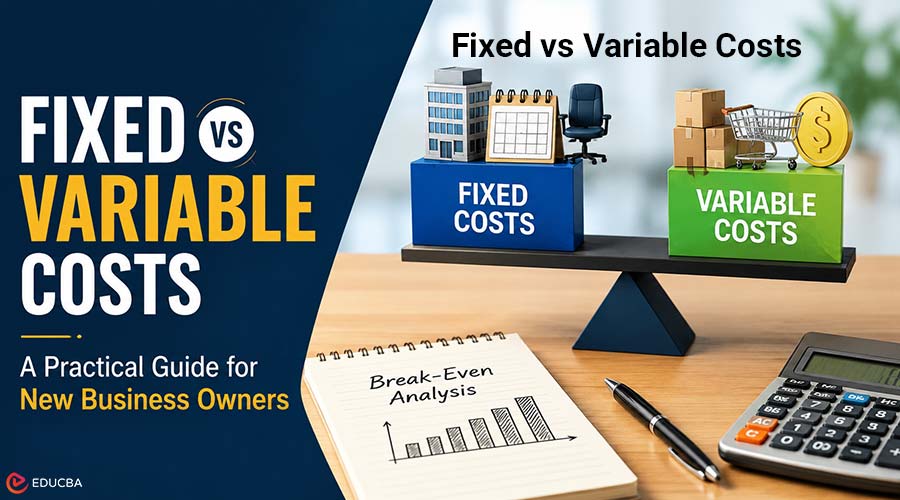
Ask a first-time business owner what their monthly costs are, and you’ll usually get one number. Ask them which of those costs would still be due if sales dropped to zero next month, and the conversation gets uncomfortable. That second question is the focus of this guide to fixed vs. variable costs.
Accountants classify expenses into fixed costs, which remain the same regardless of sales volume, and variable costs, which change with sales volume. The classification looks like bookkeeping trivia, but it is not. Research from the JPMorgan Chase Institute, based on transaction records from 600,000 small businesses, found that the median small business holds a 27-day cash buffer, about 4 weeks of expenses in reserve. A quarter holds 13 days or fewer. When your whole margin for error is two weeks of cash, the difference between a bill you can shed and a bill you can’t is the difference between a bad quarter and a shutdown.
Understanding fixed vs variable costs helps business owners make better budgeting, pricing, and growth decisions, especially when cash reserves are limited.
Fixed Costs
Rent, Salaried payroll, Insurance premiums, loan payments, most software contracts, and equipment depreciation. These arrive at the same amount whether you had your best month or your worst.
What makes fixed costs risky for a new business is not the amount but the shape of the costs. You commit to them in big blocks: a lease runs years, a salary runs indefinitely, an annual contract runs twelve months, whether you use the tool or abandon it in March. And they’re contractual. The landlord does not care that your biggest client paid late.
They have a compensating virtue. Once monthly revenue covers your fixed base, most of each additional sale drops through to profit. Accountants call this operating leverage, and it explains why a software company with high fixed engineering costs and near-zero per-unit cost becomes so profitable once it crosses the break-even point.
Variable Costs
Raw materials, inventory, payment processing fees, shipping, sales commissions, and hourly labor tied to output. Sell nothing, and most of these round to zero, which is exactly what you want when revenue is unpredictable.
The tradeoff is that they scale with you forever. A retailer paying 30% of every sale in cost of goods pays that 30% on the millionth sale too. Variable-heavy businesses rarely die suddenly, but they also have to fight for every point of margin at every size.
The Messy Middle
Plenty of real bills refuse to take sides. A utility bill is a base connection charge plus usage. A salesperson gets a base salary plus commission. Over time, maintenance, tiered SaaS pricing, all mixed.
When evaluating fixed vs. variable costs, don’t force these expenses into a single bucket. Split each into its fixed and variable parts in your books because the split changes your break-even math, and break-even math is where all of this pays off.
Break-Even: The Ten-Minute Calculation That Should Precede Every Commitment
Calculate your break-even point by dividing your total fixed expenses by the contribution margin earned on each unit, which is the selling price minus the variable cost per unit. That’s how many units you must sell before you make a dollar.
Run this before the lease, before the first salaried hire, before the annual contract. If the new break-even number exceeds your worst recent month’s sales, you’re not funding the commitment with revenue. You are funding it with optimism.
Rent Deserves More Homework Than Founders Give It
For office-based and service businesses, rent is usually the highest fixed cost after payroll and the least flexible once signed. Payroll adjusts every time you make a hiring decision. A lease sits there.
It’s also never been easier to research, and right now, some markets genuinely favor tenants. Take San Francisco: Cushman & Wakefield’s Q1 2026 MarketBeat put average office asking rent at $69.16 per square foot annually, and the city recorded the largest year-over-year drop in sublease space of any U.S. market. The vacancy rate is still high enough that a small tenant can negotiate terms and concessions in ways that were fantasy in 2019.
Before entering a quoted rent in your financial model as a fixed fact, check it against the live inventory. Founders budgeting for a Bay Area business can compare San Francisco office listings on Tandem Space and see actual asking rents by neighborhood and suite size. Whatever your city, the rule holds: a rent number you haven’t checked against at least ten comparable spaces is a guess wearing a spreadsheet cell.
Remember too that the structure of a lease is as negotiable as the rate. A shorter term with a renewal option, a tenant improvement allowance, or a few months free all shrink the real commitment without touching the headline price per square foot.
Choosing the Right Fixed vs Variable Cost Structure
Learning how fixed vs variable costs affect your business model makes it easier to decide which expenses should remain flexible during the early stages of growth.
You do not pick your industry’s economics, but at the margin, you choose plenty, and early on, the choices should mostly lean toward variable costs. Contractors before salaried staff. Month-to-month tools before annual deals. Shorter leases before longer ones. Federal Reserve survey data show that about half of small businesses experience recurring cash flow problems. If your inflows are lumpy, your outflows should stay flexible until the lumps smooth out. A fixed commitment is something your revenue history earns.
Match the length of any commitment to how far ahead you can actually see. Six-month client contracts don’t justify a five-year lease. Two-year enterprise contracts might.
And hold cash in proportion to your fixed base, because those are the bills that arrive no matter what. The JPMorgan data shows median buffers ranging from 16 days at restaurants to 47 days at real estate firms, a target worth writing down: three months of fixed costs in the bank.
Final Thoughts
Understanding fixed vs variable costs is about more than organizing expenses; it is about making smarter business decisions. Every fixed cost is a bet that your revenue will continue to grow, while every variable cost gives you greater flexibility when sales fluctuate. For new businesses, maintaining that flexibility can reduce financial risk during the early stages.
As your business grows, regularly review your cost structure, monitor your break-even point, and shift from variable to fixed commitments only when your revenue consistently supports them. Many businesses succeed not because they have the best product from day one, but because a well-managed cost structure gives them the time and financial stability to improve. In the end, understanding fixed vs variable costs helps you build a business that can withstand uncertainty and grow sustainably.
Recommended Articles
We hope this guide on fixed vs variable costs helps you build a stronger financial foundation and make more informed business decisions. Explore these recommended articles for additional insights on budgeting, break-even analysis, cash flow management, and cost optimization to support your business growth.


