
What is Workforce Forecasting?
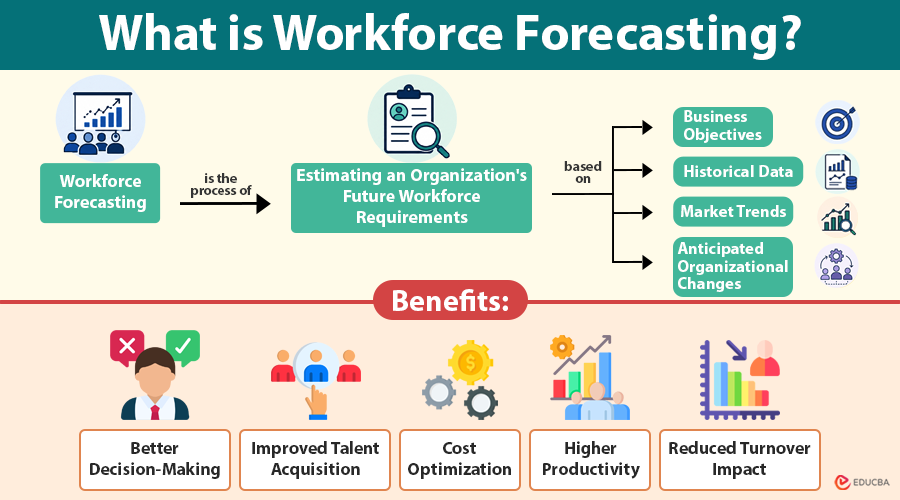
Workforce forecasting is the process of estimating an organization’s future workforce requirements based on business objectives, historical data, market trends, and anticipated organizational changes.
It involves predicting:
- The number of employees required in the future.
- The skills and competencies needed.
- Potential workforce shortages or surpluses.
- Employee turnover and retirement rates.
- Future recruitment and training needs.
In simple terms, workforce forecasting helps organizations prepare for future talent demands rather than reacting to workforce issues after they arise.
For example, suppose a software company plans to expand internationally within two years. Workforce forecasting may predict the need for additional developers, multilingual support staff, and international sales managers, allowing the company to hire and train employees in advance.
Table of Contents:
Key Takeaways:
- Workforce forecasting effectively aligns future talent requirements with long-term business objectives.
- Accurate forecasting helps organizations proactively address skill gaps and staffing shortages.
- Data-driven forecasting improves recruitment, succession planning, and overall workforce efficiency.
- Continuous workforce forecasting enhances organizational agility and minimizes future business risks.
Importance of Workforce Forecasting
Workforce forecasting plays an important role in organizational success.
1. Supports Strategic Planning
Aligns workforce requirements with long-term business objectives, expansion strategies, and future organizational growth plans.
2. Identifies Skill Gaps
Helps organizations identify missing competencies and effectively prepare employees for future job requirements.
3. Improves Recruitment Planning
Enables HR teams to proactively recruit talent before workforce shortages significantly disrupt business operations.
4. Reduces Labor Costs
Prevents overstaffing and understaffing, helping organizations optimize labor expenses and improve operational efficiency.
5. Enhances Succession Planning
Identifies potential future leaders, ensuring smooth leadership transitions and organizational continuity over time.
6. Minimizes Business Risks
Anticipates workforce disruptions from retirements, resignations, or market changes, reducing business uncertainty.
Types of Workforce Forecasting
Organizations typically use different forecasting types depending on their objectives.
1. Demand Forecasting
Demand forecasting estimates future employee numbers and skill requirements needed to achieve organizational objectives and planned business growth.
2. Supply Forecasting
To determine whether future labor needs can be met, supply forecasting assesses the availability of internal and external talent.
3. Internal Workforce Forecasting
Internal workforce forecasting predicts future talent availability within organizations by analyzing employee movements, promotions, and retention.
4. External Workforce Forecasting
External workforce forecasting effectively assesses labor market conditions to identify future talent availability outside organizational boundaries.
Methods of Workforce Forecasting
Organizations use several quantitative and qualitative methods to forecast workforce requirements.
1. Trend Analysis
Trend analysis examines historical workforce patterns and uses past staffing data to accurately predict future employee requirements.
2. Ratio Analysis
Ratio analysis estimates workforce needs by analyzing relationships between business activities, productivity metrics, and employee numbers.
3. Delphi Technique
The Delphi technique collects expert opinions through repeated surveys to forecast workforce requirements when historical data is insufficient.
4. Scenario Planning
Scenario planning evaluates various future business situations and determines corresponding workforce requirements under different potential circumstances.
5. Managerial Judgment
Managerial judgment relies on managers’ experience, knowledge, and expectations to effectively estimate future staffing requirements.
6. Regression Analysis
Regression analysis applies statistical techniques to identify relationships between workforce needs and influential business variables.
7. Predictive Analytics
Predictive analytics uses data, artificial intelligence, and algorithms to forecast workforce trends and future talent requirements.
Workforce Forecasting Process
A structured forecasting process improves prediction accuracy.
Step 1: Define Business Objectives
Begin by understanding organizational goals, such as:
- Expansion plans.
- New product launches.
- Market entry strategies.
- Digital transformation initiatives.
Step 2: Analyze Current Workforce
Assess the existing workforce by evaluating:
- Employee headcount.
- Skills and competencies.
- Demographics.
- Performance levels.
- Diversity metrics.
Step 3: Forecast Future Workforce Demand
Estimate future staffing needs based on strategic objectives and projected business activities.
Step 4: Forecast Workforce Supply
Determine future workforce availability by analyzing:
- Internal talent pipelines.
- Turnover trends.
- Retirement projections.
- Labor market conditions.
Step 5: Identify Workforce Gaps
Compare projected demand with expected workforce supply.
Potential gaps may include:
- Skill shortages.
- Leadership shortages.
- Staffing surpluses.
Step 6: Develop Action Plans
Create strategies to address identified gaps.
Possible actions include:
- Recruitment initiatives.
- Employee training programs.
- Succession planning.
- Reskilling and upskilling.
- Workforce restructuring.
Step 7: Monitor and Update Forecasts
Workforce forecasts should be continuously reviewed and updated to reflect changing business conditions.
Benefits of Workforce Forecasting
Organizations implementing it gains numerous benefits.
1. Better Decision-Making
Supports data-driven workforce decisions, enabling organizations to plan resources and strategies more effectively.
2. Improved Talent Acquisition
Enables proactive hiring strategies, ensuring qualified talent is available before workforce shortages occur.
3. Cost Optimization
Reduces unnecessary staffing expenses by preventing overstaffing, understaffing, and inefficient resource allocation.
4. Higher Productivity
Ensures adequate staffing levels, helping employees maintain efficiency and consistently achieve organizational objectives.
5. Reduced Turnover Impact
Anticipates employee departures and succession needs, minimizing disruptions from workforce transitions.
Challenges in Workforce Forecasting
Despite its benefits, it presents several challenges.
1. Uncertain Business Environment
Economic fluctuations, market disruptions, and global events can rapidly and unexpectedly change organizational workforce requirements.
2. Inaccurate Data
Poor-quality or incomplete workforce data reduces forecasting accuracy and leads to ineffective workforce planning decisions.
3. Rapid Technological Change
Automation and digital transformation continuously alter job roles, creating new skill requirements and workforce challenges.
4. Changing Employee Behavior
Evolving employee preferences, turnover patterns, and remote work expectations make workforce predictions increasingly difficult.
5. Limited Predictive Capability
Historical workforce data may not accurately predict future talent needs in rapidly changing business environments.
6. Skills Obsolescence
Employee skills can quickly become outdated due to technological advancements and changing industry practices.
Workforce Forecasting Tools
Several HR and analytics tools support workforce forecasting, including:
1. Microsoft Power BI
Microsoft Power BI offers analytics and data visualization tools for predicting workforce trends and staffing requirements.
2. SAP SuccessFactors
SAP SuccessFactors offers workforce planning, talent management, and predictive analytics capabilities to support strategic HR decisions.
3. Workday
Workday enables organizations to analyze workforce data, forecast talent requirements, and optimize staffing strategies effectively.
4. Oracle HCM Cloud
Oracle HCM Cloud provides workforce analytics, succession planning, and forecasting capabilities for future talent demands.
5. Visier
Visier delivers people analytics solutions that help organizations predict workforce trends and identify potential risks.
6. Tableau
Tableau visualizes workforce data through interactive dashboards, supporting informed forecasting and strategic workforce planning.
Final Thoughts
Workforce forecasting is a vital workforce planning process that helps organizations anticipate future talent needs and prepare proactively. By analyzing workforce data, business goals, and market trends, organizations can optimize hiring, training, succession planning, and resource allocation, ensuring agility, reduced staffing risks, cost efficiency, and sustained long-term business success.
Frequently Asked Questions (FAQs)
Q1. How often should organizations update workforce forecasts?
Answer: Organizations should review and update workforce forecasts at least quarterly or whenever significant business changes occur, such as mergers, expansions, economic shifts, or major technology implementations.
Q2. Is workforce forecasting only beneficial for large organizations?
Answer: No. It is beneficial for companies of all sizes. Small and medium-sized organizations can use forecasting to manage hiring costs, prepare for growth, and ensure adequate staffing levels.
Q3. How does remote work affect workforce forecasting?
Answer: Remote work expands talent pools beyond geographical boundaries and changes staffing models. Organizations must consider remote workforce availability, collaboration requirements, and flexible work arrangements during forecasting.
Q4. How does workforce forecasting support diversity and inclusion initiatives?
Answer: Workforce forecasting helps organizations identify representation gaps, establish diversity hiring goals, and develop inclusive talent strategies that align with long-term business objectives.
Recommended Articles
We hope that this EDUCBA information on “Workforce Forecasting” was beneficial to you. You can view EDUCBA’s recommended articles for more information.

