


What is Net National Product?
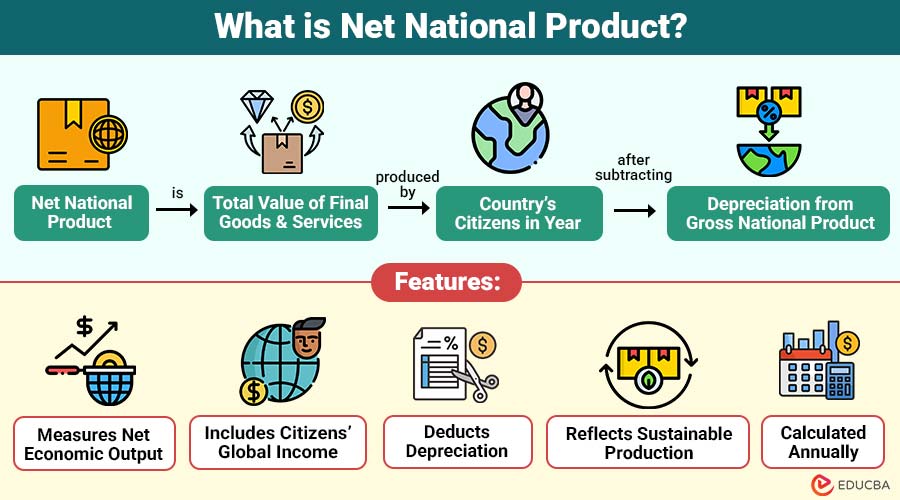
Net National Product (NNP) refers to the total monetary worth of finished goods and services generated by the citizens of a country during a specific period, usually one year, after deducting depreciation from Gross National Product (GNP).
Depreciation means the loss in value of fixed assets such as machinery, factories, equipment, and vehicles due to continuous use, wear and tear, or aging. By subtracting depreciation, NNP provides a clearer and more realistic measure of a nation’s actual economic output and sustainable growth.
Table of Contents:
- Meaning
- Formula
- Importance
- Features
- Components
- Advantages
- Disadvantages
- Factors Affecting Net National Product
- Methods
- Example
Key Takeaways:
- Net National Product measures national output after deducting depreciation from Gross National Product annually.
- NNP reflects sustainable economic growth by accounting for wear and tear of capital assets.
- Governments and economists use NNP to plan, make policy decisions, and compare economic performance globally.
- Higher industrial production, employment, and technology advancement generally increase a country’s net national product.
Formula of Net National Product
The formula for calculating NNP is:
Where:
- NNP = Net National Product
- GNP = Gross National Product
- Depreciation = Loss in value of fixed assets over time
Importance of Net National Product
Here are the major reasons why NNP is important for measuring a country’s economic performance and long-term growth.
1. Helps Measure Economic Health
NNP measures sustainable economic growth after accounting for depreciation and capital asset replacement costs.
2. Useful for Economic Planning
Governments use NNP data for taxation, budgeting, investment planning, and economic policy development purposes.
3. Reflects Actual National Income
NNP accurately reflects the actual national income available for household consumption, savings, and investment in productive capital.
4. Assists in Comparing Economies
Economists compare NNP values internationally to assess countries’ economic strength and development performance.
5. Indicates Capital Maintenance
NNP indicates the remaining production value after replacing all damaged, outdated, or depreciated capital assets.
Features of Net National Product
Here are the key features that help explain its role in measuring a country’s actual and sustainable economic performance.
1. Measures Net Economic Output
Measures actual national production after subtracting depreciation from total economic output annually.
2. Includes Citizens’ Global Income
Includes income earned by citizens and businesses within the country and from foreign sources.
3. Deducts Depreciation
NNP deducts depreciation costs arising from machinery wear, aging infrastructure, and declines in asset value.
4. Reflects Sustainable Production
It reflects sustainable economic growth by accounting for the replacement costs of damaged or outdated capital assets.
5. Calculated Annually
Governments generally calculate the net national product annually to accurately assess national income and economic performance.
Components of Net National Product
It consists of several important components.
1. Consumer Spending
Consumer spending includes household expenditures on food, clothing, healthcare, education, transportation, entertainment, and other daily necessities.
2. Government Expenditure
Government expenditure covers spending on infrastructure, defense, healthcare, education, welfare programs, administration, and essential public services nationwide.
3. Investments
Investments include business expenditures on factories, machinery, equipment, technology, construction projects, and production capacity expansion activities.
4. Net Foreign Income
Net foreign income measures citizens’ overseas earnings minus income earned domestically by foreign individuals and foreign companies.
5. Depreciation
Depreciation represents a gradual reduction in the value of a fixed asset caused by usage, wear, aging, and technological obsolescence over time.
Advantages of Net National Product
Here are some major advantages of NNP in measuring economic performance and supporting national economic decisions.
1. Provides Realistic Economic Data
NNP provides accurate economic production data by accounting for depreciation and reductions in capital asset value.
2. Helps in Long-Term Planning
Governments use NNP statistics for sustainable economic planning, budgeting, infrastructure development, and future policy decisions.
3. Measures Economic Welfare Better
NNP reflects available goods and services after replacing depreciated assets, thereby improving the accuracy of economic welfare measurement.
4. Useful for Investment Decisions
Businesses and investors analyze NNP trends to assess economic stability, growth potential, and investment opportunities.
5. Supports Productivity Analysis
Economists use NNP data to accurately measure national productivity, operational efficiency, and long-term economic performance.
Disadvantages of Net National Product
Here are some major disadvantages of NNP that affect its accuracy and overall economic analysis.
1. Difficult to Measure Depreciation
Calculating accurate depreciation values for national assets is complex because asset lifespans vary.
2. Does Not Measure Income Distribution
NNP fails to show whether national income and wealth are equally shared among population groups.
3. Ignores Non-Market Activities
Household services and unpaid domestic work remain excluded from national income measurement calculations.
4. Environmental Costs Are Excluded
Environmental pollution and natural resource depletion costs are not accounted for in NNP calculations.
5. Data Collection Challenges
Gathering accurate production and depreciation statistics requires extensive surveys and advanced statistical systems.
Factors Affecting Net National Product
Here are the major factors that influence NNP and impact a country’s overall economic performance.
1. Industrial Production
Increased industrial production raises national output, contributing significantly toward a higher overall net national product.
2. Employment Levels
Higher employment levels increase workforce productivity, boosting income generation and overall national economic output.
3. Technology
Advanced technology improves production efficiency, increases productivity, and supports growth in national income levels.
4. Inflation
High inflation reduces purchasing power, thereby negatively affecting real national income and overall economic stability.
5. Depreciation Rate
Higher depreciation rates decrease asset values, reducing overall net national product and economic growth potential.
Methods of Calculating Net National Product
Economists use different methods to calculate NNP.
1. Income Method
Measures total earnings received by labor, businesses, and property owners within the national economy.
2. Production Method
Calculates total market value of final goods and services produced during specific periods.
3. Expenditure Method
Measures total spending by households, businesses, governments, and foreign buyers on goods and services.
Example
Here is a simple example to understand how Net National Product (NNP) is calculated.
Suppose a country has:
- Gross National Product = $5 trillion
- Depreciation = $500 billion
Then:
NNP=5 trillion−0.5 trillion=4.5 trillion
So, the country’s Net National Product is $4.5 trillion. This means the economy produced goods and services worth $4.5 trillion after accounting for depreciation.
Final Thoughts
Net National Product measures a country’s total goods and services value after deducting depreciation from gross national product. It reflects sustainable economic growth and actual productive capacity. Governments, economists, businesses, and investors use NNP for economic planning, policy evaluation, investment decisions, and comparing national economic performance internationally.
Frequently Asked Questions (FAQs)
Q1. Why is depreciation deducted in net national product?
Answer: Depreciation is deducted to measure the actual net production after accounting for the wear and tear of assets.
Q2. Can net national product be negative?
Answer: Yes, NNP can become negative if depreciation exceeds the total national production value during a specific period.
Q3. How often is net national product calculated?
Answer: Most governments calculate NNP annually as part of national income accounting and economic performance analysis.
Recommended Articles
We hope that this EDUCBA information on “Net National Product” was beneficial to you. You can view EDUCBA’s recommended articles for more information.


