


Managing HR in an educational institution is complex, and even more so across multiple branches or campuses. Each location may have its own administrative processes, staffing structures, payroll variations, and compliance requirements, yet all branches are expected to function as a unified system. Relying on spreadsheets or disconnected tools in such scenarios often leads to inefficiencies, data inconsistencies, and delays. This is why implementing a robust Human Resource Management System (HRMS) is essential for multi-branch educational institutions aiming to scale while maintaining operational control. However, selecting the right HRMS software is not simply about choosing software with the most features. It requires a clear understanding of institutional needs, future scalability, and the ability to manage distributed teams seamlessly.
Understanding the Unique Needs of Multi-branch Institutions
Educational institutions differ from traditional corporate organizations in several ways, particularly in how they manage staff roles, academic calendars, and regulatory obligations. When multiple branches are involved, these differences become even more pronounced. For instance, faculty contracts may vary across campuses, attendance policies may differ based on local regulations, and payroll structures may include diverse components such as academic incentives, administrative allowances, or contractual payments.
Without a centralized system, managing these variables becomes both time-consuming and error-prone. An effective HRMS should therefore not only centralize data but also accommodate the flexibility required to handle such variations without disrupting overall organizational consistency.
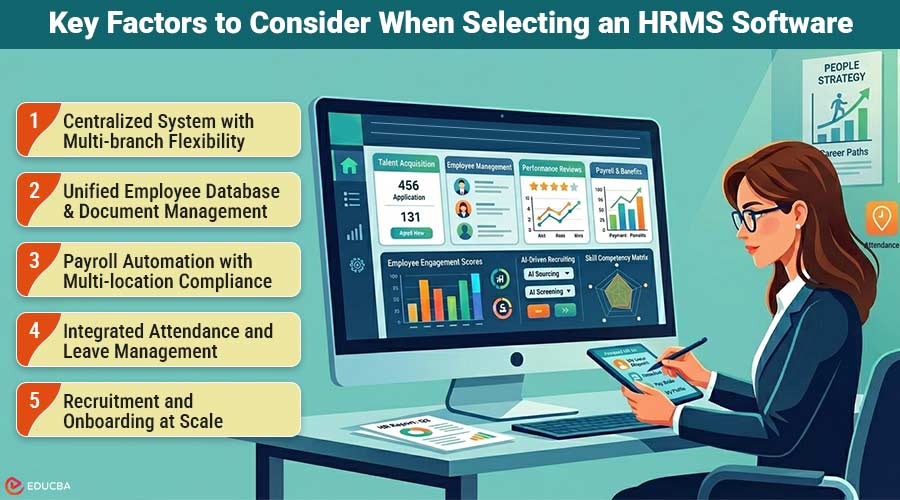
Key Factors to Consider When Selecting an HRMS Software
Below are the essential factors you should evaluate before choosing the right HRMS software for your organization.
1. Centralized System with Multi-branch Flexibility
One of the most critical requirements for a multi-branch institution is the ability to manage all campuses through a single, unified platform while still allowing controlled access at the branch level. The HRMS should enable centralized monitoring of operations, including workforce data, payroll, and performance metrics, while allowing individual branches to manage their day-to-day activities independently.
Role-based access controls are particularly important here, as they ensure that administrators, HR personnel, and management teams have access only to the data relevant to their responsibilities. This balance between centralization and flexibility is what allows institutions to maintain consistency without restricting operational autonomy.
2. Unified Employee Database and Document Management
In a distributed environment, employee data often gets fragmented across departments and locations, making it difficult to maintain accuracy and consistency. A reliable HRMS should provide a single, unified database that stores and updates employee information in real time. This includes personal details, employment history, contracts, certifications, and compliance-related documentation.
Having a centralized repository not only improves data accuracy but also simplifies processes such as audits, reporting, and internal reviews. It eliminates duplication and ensures that all stakeholders use the same, up-to-date information.
3. Payroll Automation with Multi-location Compliance
Payroll management in educational institutions is rarely straightforward, especially when multiple branches operate under different regional regulations. An effective HRMS must handle complex payroll structures, including variations in salary components, deductions, and benefits.
Additionally, it should support compliance with local labor laws, tax regulations, and statutory requirements across different locations. Automation plays a vital role by reducing manual work, minimizing errors, and ensuring timely salary processing. Over time, this not only improves operational efficiency but also builds trust among employees.
4. Integrated Attendance and Leave Management
Tracking attendance across multiple campuses can quickly become unmanageable without the right tools, particularly when institutions rely on manual systems or disconnected devices. Modern HRMS platforms offer integrated attendance solutions that link with biometric systems, mobile applications, or web-based check-ins.
These systems provide real-time visibility into attendance data and seamlessly integrate it with payroll and performance tracking. Similarly, leave management should be automated and standardized across branches, allowing employees to apply for leave through self-service portals while enabling managers to review and approve requests efficiently.
5. Recruitment and Onboarding at Scale
As institutions expand, the need to hire faculty and administrative staff across multiple locations becomes more frequent and complex. An HRMS with built-in recruitment and onboarding capabilities can streamline this process by centralizing candidate data, standardizing interview workflows, and ensuring consistency in hiring practices.
It also enables faster onboarding by digitizing documentation and reducing manual coordination between departments. This not only improves hiring efficiency but also ensures that new employees have a consistent experience regardless of the branch they join.
6. Employee Self-Service and Experience
In large institutions, HR teams often spend significant time addressing routine employee queries about payslips, leave balances, or personal information updates.
An HRMS with a well-designed employee self-service (ESS) portal empowers staff to access and manage their own information without relying on HR for every request. This reduces administrative workload and enhances employee satisfaction by providing transparency and convenience.
7. Data-Driven Insights and Reporting
With multiple branches generating large volumes of data, having access to meaningful insights becomes crucial for decision-making. A good HRMS should offer advanced reporting and analytics capabilities, enabling leadership to monitor workforce trends, identify inefficiencies, and make informed strategic decisions.
Whether it is tracking attendance patterns, analyzing payroll expenses, or evaluating staff performance, these insights can significantly impact institutional growth.
8. Cloud-based Infrastructure and Accessibility
Given the distributed nature of multi-branch institutions, cloud-based HRMS solutions are increasingly becoming the preferred choice.
Cloud platforms allow users to access the system from any location, ensuring real-time updates and seamless collaboration between branches. They also reduce the need for on-premise infrastructure, making them more scalable and cost-effective in the long run.
Common Mistakes Institutions Should Avoid
While selecting an HRMS, institutions often focus heavily on features without considering long-term usability and scalability. Some common mistakes include choosing software designed primarily for corporate environments rather than educational institutions, underestimating the importance of compliance capabilities, or failing to evaluate the level of customization and vendor support. It is also important to consider how easily the system can adapt as the institution grows, as switching platforms later can be both costly and disruptive.
Why Yomly is a Strong Choice for Enterprise-level Educational Institutions?
Image Source: Yomly
For educational institutions with multiple branches, selecting an HRMS capable of handling enterprise-level complexity is essential. Yomly stands out in this regard as a platform for efficiently and precisely managing distributed workforces. Its architecture supports centralized HR operations while allowing flexibility at the branch level, making it particularly suitable for institutions with multiple campuses. The platform offers robust payroll and compliance management, enabling institutions to navigate diverse regulatory requirements without additional administrative burden.
Additionally, its ability to customize workflows allows educational organizations to align the system with their specific operational needs rather than adapting their processes to fit the software. By bringing all HR functions into a single, integrated platform, Yomly enables institutions to streamline operations, improve data accuracy, and enhance overall efficiency, which is critical for organizations looking to scale sustainably.
Choosing an HRMS That Supports Long-term Expansion
Choosing the right HRMS software for a multi-branch educational institution is a strategic decision that goes beyond immediate operational needs. It requires careful consideration of scalability, flexibility, compliance, and user experience. A well-implemented HRMS not only simplifies administrative processes but also strengthens the institution’s foundation by enabling better workforce management. As educational organizations continue to expand, investing in the right system becomes essential for maintaining consistency, improving efficiency, and supporting long-term growth.
Final Thoughts
The right HRMS software can transform how multi-branch educational institutions manage their workforce. From streamlining payroll and attendance to improving decision-making through data insights, it plays a crucial role in operational efficiency. By choosing a scalable, flexible, and compliance-ready HRMS software, institutions can not only manage complexity but also position themselves for sustainable growth.
Recommended Articles
We hope this comprehensive guide to HRMS software helps you streamline workforce management in your institution. Check out these recommended articles for more insights and strategies to optimize your HR processes and organizational efficiency.


