


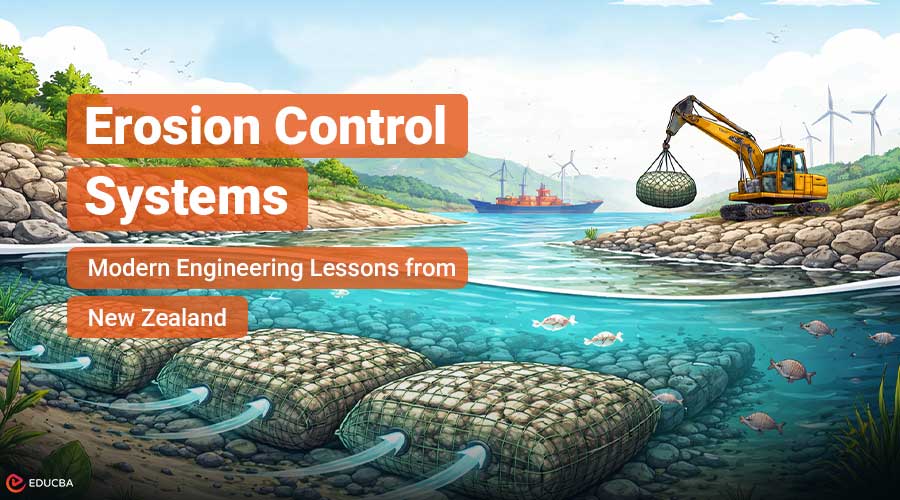
There is a point in every serious project where theory alone is no longer sufficient. Plans meet pressure, assumptions meet reality, and what looked solid on paper gets tested by forces that do not care about design intent. This is where erosion control systems prove their true value—not in theory, but in real-world performance under extreme conditions.
Rethinking Force: The Mechanics of Energy Dissipation
Water does not just hit — it reacts. When it meets a rigid surface, it rebounds, often doubling its impact on the seabed below, breaking rocks and soil and altering their composition. That is where many traditional defenses quietly fail.
What changes the outcome is how you handle that energy:
- Porous structures slow water internally, not externally
- Stone-to-stone friction breaks momentum into smaller, harmless movements
- Elimination of the Ricochet Effect: Neutralizes the destructive rebound force.
This shift is particularly visible in erosion mitigation across New Zealand, as the Resource Management Act (RMA) and a national commitment to sustainability set a high regulatory and ethical bar. For you, whether you are investing or building, this is about understanding that durability comes from how forces are managed, not from resisting them. Think of it less like a wall and more like a filter. You are not stopping water—you are making it lose its strength before it becomes a problem.
Staying Grounded: Why Shape Adaptability Matters
One of the most expensive failures in infrastructure is not collapse—it is separation. The moment a structure loses contact with its base, everything else becomes irrelevant. Here is the reality: the ground beneath coastal and subsea systems is always moving.
- Flexible systems settle into voids instead of bridging over them
- Continuous contact prevents weak points from forming
- Weight distribution adjusts naturally as conditions change
Rigid structures do not fail because they are weak—they fail because they refuse to adapt. Collectively, these strategies help achieve adaptive geotechnical integrity by moving away from “monolithic” (rigid) structures toward particulate systems that serve as key mechanisms for soil conservation at the water’s edge. Stability is not about staying fixed—it is about staying connected, no matter how the ground behaves.
When Infrastructure Becomes Alive: Bio-Geotechnical Advantage
Now here is something most engineering conversations do not highlight enough—over time, some systems actually improve. In marine environments, certain materials invite life:
- Marine organisms attach and grow within the structure
- Sediment fills gaps, increasing density naturally
- Biological activity binds materials together over time
What starts as an engineered solution gradually becomes part of the environment itself. For stakeholders, this is more than sustainability—it is performance that improves over time. Instead of degrading, the system evolves, gaining strength and stability in ways that no purely artificial structure can replicate.
Timing Is Everything: The Power of Deployment Strategy
You can have the best solution in the world—but if you can not deploy it when it matters, it is useless. In erosion scenarios, delays are costly. Small issues escalate quickly.
- Pre-prepared units allow immediate action
- Offsite preparation reduces on-site complexity
- Rapid placement prevents minor damage from spreading
This is where operational thinking becomes just as important as engineering. If you are overseeing projects, this is your leverage point. You are not just choosing materials—you are choosing how quickly you can respond when conditions shift. And in this field, speed often determines whether you are repairing or rebuilding.
Managing Man-Made Forces with Advanced Erosion Control Systems
It is easy to focus on natural erosion, but in many environments, the biggest threat comes from us. Ports, harbors, and industrial zones introduce forces that exceed natural conditions:
- Propeller wash creates intense, localized currents
- Repeated vessel movement amplifies stress over time
- Loose materials get displaced faster than expected
What works in open water often fails here. The solution? Systems that behave as a single mass:
- Higher resistance to movement
- No individual components to dislodge
- Consistent protection under repeated stress
For operators and developers, this is about foresight. The real challenge is designing for both natural forces and the impact of your own operations.
Sustainable Materials in Modern Erosion Control Systems
Let us talk about something that is no longer optional—what your systems are made of. Today, material selection is not just about strength. It is about lifecycle, compliance, and long-term impact.
- Recycled materials reduce environmental footprint
- High resistance to UV and salinity ensures longevity
- Lower lifecycle costs through reduced replacement needs
But here is the real shift—regulators, communities, and investors are all paying attention. This means your choices affect more than performance:
- Project approvals
- Public perception
- Long-term viability
In other words, material selection has become a strategic decision rather than just a technical one. Using 100% recycled PET mesh is not just a technical preference; it is a prerequisite for project approval and long-term alignment with New Zealand’s Kaitiakitanga (guardianship) values.
Protecting What You Can’t See: Subsea Asset Stability
Some of the most critical infrastructure today sits out of sight—cables, pipelines, and energy systems running along the seabed.
And their biggest threat? Movement.
- Currents create lift forces that destabilize assets
- Unsupported spans lead to long-term structural fatigue
- Small vibrations compound into major failures
What works here is subtle but powerful:
- Cover systems that reshape water flow around the asset
- Added weight to keep everything grounded
- Stabilization that prevents motion before it starts
For energy developers and infrastructure investors, this is where reliability is defined. In these environments, protecting assets and ensuring continuity are the same — failure simply is not an option.
The “Acoustic Dampening” of Marine Environments
The Theory:
Rigid concrete seawalls act as “acoustic mirrors,” reflecting sound from waves and vessel engines back into the water column, contributing to anthropogenic noise pollution.
The Application:
Because Rockbags are high-porosity structures—filled with irregular voids—they function as underwater sound baffles. When wave energy or vessel noise (like bow thrusters) interacts with them, the energy is scattered and absorbed within the internal stone matrix rather than reflected.
Learning Aspect:
In modern environmental planning, “quiet infrastructure” is becoming a regulatory and ecological priority. Deploying Rockbags in locations such as Stockton Beach or the Port of Lyttelton does not just stabilize shorelines—it also reduces acoustic stress on marine mammals and fish. This creates a form of sensory-integrated coastal defense that aligns engineering performance with ecological sensitivity.
Forensic Transparency and “Failure Traceability”
The Theory:
In traditional “hard” engineering, when a concrete structure fails, it often collapses catastrophically (“pancakes”), burying the original cause of failure and obscuring the forensic trail.
The Application:
Rockbags offer what can be called visual diagnostic integrity. Because they are modular and discrete units, engineers and surveyors can directly observe where settlement, displacement, or scour is occurring.
Learning Aspect:
This enables forensic maintenance rather than reactive reconstruction. Instead of waiting for total structural failure, coastal managers can “read” the system—interpreting how individual units have shifted in response to seabed dynamics.
Insight:
That way, if the “data map” (the settling bags) shows a weakness in one specific 5-meter stretch, you simply drop two or three more pre-filled bags into that exact spot.
The Logic:
You are treating the symptom before it becomes a disease. This prevents the “cascading failure” that usually leads to total structural collapse.
Final Thoughts
Engineers design modern erosion control systems to perform under real-world conditions, whether preventive or corrective—it is about creating infrastructure that performs under change, not just under ideal conditions. In this framework, Rockbags act as the “flesh” of the coastal defense—absorbing, adapting, and interacting with the environment. But like any living system, their performance depends on the underlying “skeleton”: quality design, proper installation, and engineering integrity. Ensuring high-quality builds is key to delivering solutions that are not only durable but also resilient, maintainable, and environmentally aligned over the long term.
Recommended Articles
We hope this guide on erosion control systems helps you understand modern solutions—explore these recommended articles for more insights and practical strategies.

