
What is a Value Proposition?
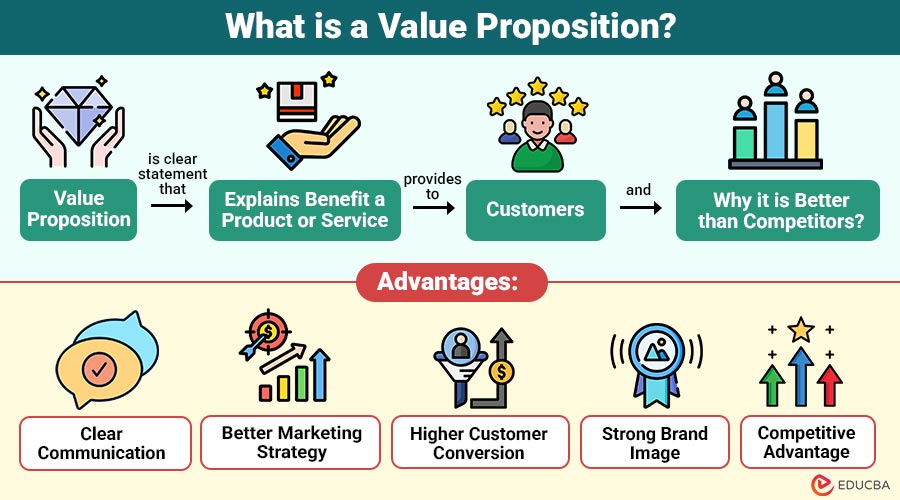
A value proposition is a clear statement that explains benefit a product or service provides to customers and why it is better than competitors. It also describes what makes the product or service distinct and why customers should select it over other options.
It answers three important questions:
- What problem does the product solve?
- What benefits does the customer receive?
- Why should the customer choose this product?
Examples:
- Fast delivery at a low cost
- High-quality product at an affordable price
- Easy-to-use software with advanced features
Table of Contents:
- Meaning
- Importance
- Key Elements
- Types
- How to Create a Value Proposition?
- Real-World Examples
- Advantages
- Disadvantages
- Tips
Key Takeaways:
- A value proposition clearly explains the product’s benefits, target customers, and why it is better than competitors.
- A strong value proposition helps attract customers, improve marketing messages, build trust, and increase sales.
- Good value propositions focus on customer problems, highlight benefits, show uniqueness, and use simple, clear language.
- Businesses should update their value propositions regularly to align with customer needs, market changes, and competition for better results.
Why is the Value Proposition Important?
It is important for business success in many ways, such as the following:
1. Attracts Customers
A clear value proposition helps customers quickly understand the product’s benefit, making them interested and more likely to choose it.
2. Builds Trust
When the value proposition is clear and honest, customers feel confident about the brand, making the business appear reliable and professional.
3. Improves Marketing
Marketing becomes easier because the business clearly knows what message to share, helping advertisements stay focused, simple, and effective.
4. Increases Sales
When customers clearly see the benefits and usefulness of a product, they feel more confident and are more likely to make purchases.
5. Defines Brand Identity
A strong value proposition explains what makes the business different, helping customers remember the brand and understand its unique purpose.
Key Elements of Value Proposition
It usually includes the following important elements:
1. Headline
A headline is a succinct, straightforward statement that draws readers in and emphasizes the primary advantage of a product or service.
2. Subheadline
A subheadline provides additional explanation about the product or service, describing how it works and why it is useful for customers.
3. Benefits
Benefits describe the advantages customers receive from the product or service, explaining how it solves problems and improves their experience or satisfaction.
4. Unique Selling Point
A unique selling point is a feature that makes a product stand out from competitors and gives customers a strong reason to choose it.
5. Proof or Evidence
Proof or evidence includes facts, reviews, ratings, or results that show the product works well and helps customers trust the business.
Types of Value Proposition
Different businesses use different types:
1. Price-Based Value Proposition
In order to draw in customers on a tight budget, it concentrates on providing goods and services at reduced price without sacrificing quality.
2. Quality-Based Value Proposition
It highlights superior materials, craftsmanship, reliability, or durability to attract customers who prefer premium and high-performance products or services.
3. Convenience-Based Value Proposition
It focuses on saving time and effort by making the product easy to access, simple to use, and quickly available.
4. Performance-Based Value Proposition
It emphasizes faster speed, greater power, greater efficiency, or better results than competitors, attracting customers seeking higher productivity and reliability.
5. Innovation-Based Value Proposition
It focuses on new technology, unique features, or creative ideas that provide advanced solutions not offered by existing competitors.
6. Customer Experience-Based
It focuses on excellent service, support, and satisfaction to create trust, loyalty, and long-term relationships with customers.
How to Create a Value Proposition?
You can create by following these simple steps:
Step 1: Identify Target Customers
Identify the specific group of people who will use the product by understanding their age, needs, interests, and buying behavior clearly.
Step 2: Understand Customer Problems
Understand the main problems, difficulties, or needs customers face so the product can be designed to provide a useful and practical solution.
Step 3: Explain Your Solution
Clearly describe how your product or service resolves consumer issues and improves the ease, speed, affordability, or convenience of their work.
Step 4: Highlight Benefits
Describe the main benefits customers will receive from the product, such as saving time, reducing cost, improving comfort, or increasing productivity in daily tasks.
Step 5: Show Difference from Competitors
Explain what makes your product different and better than competitors by focusing on unique features, better quality, lower price, or extra advantages offered.
Step 6: Write a Short and Clear Statement
Write the value proposition in one short, simple, and clear sentence so customers can quickly understand the main benefit without confusion or extra reading.
Real-World Examples
Here are some real-world companies that clearly show strong value propositions through their products and services.
1. Apple
Apple offers premium design, high performance, and a smooth user experience, attracting customers seeking reliable, stylish, high-quality technology products with strong brand value.
2. Google
Google delivers fast, accurate, and free search results, helping users quickly find information online, making it one of the most trusted internet services worldwide.
3. Uber
Uber allows users to book rides anytime using a mobile app, providing quick, convenient, and reliable transportation without waiting for traditional taxi services.
4. Zoom
Zoom offers simple, high-quality video meetings with easy connection, helping people communicate online smoothly for business, education, and personal use from anywhere.
Advantages of Value Proposition
Below are the key advantages:
1. Clear Communication
Helps customers quickly understand the product, making it easier for them to understand its purpose and benefits.
2. Better Marketing Strategy
A strong guide marketing efforts, helping businesses create focused advertisements, campaigns, and messages that attract the right target audience.
3. Higher Customer Conversion
When customers clearly see the value and benefits, they feel confident about the product, increasing the chances of purchase and improving conversion rates.
4. Strong Brand Image
A well-defined value proposition makes the business look professional, trustworthy, and organized, helping customers easily develop a positive, lasting impression.
5. Competitive Advantage
A unique value proposition helps a business stand out in the market by showing customers why it is better than competitors.
Disadvantages of Value Proposition
Below are some common disadvantages in business:
1. Difficult to Create
Creating a strong value proposition requires deep research, planning, and understanding of market needs, which can take significant time and effort.
2. Must Be Updated Often
Must be revised frequently to remain current and useful as consumer demands and market trends change over time.
3. Can Be Copied by Competitors
Competitors may copy or create similar value propositions, making it harder for a business to stay unique and maintain a competitive advantage.
4. Wrong Message Can Confuse Customers
If it is unclear or misleading, customers may not understand the product, leading to confusion and reduced trust in the brand.
5. Needs Customer Understanding
The value proposition may not be able to draw in the appropriate target audience if the wants, preferences, and issues of the consumer are not clearly understood.
Tips for Writing a Strong Value Proposition
Here are some useful tips to help you write a clear, simple, and effective value proposition:
1. Keep it Short
Write in a short and clear sentence so customers can quickly understand the message without confusion or effort.
2. Use Simple Words
Use simple and easy words so every customer can understand the value without needing technical knowledge or extra explanation from the business.
3. Focus on Benefits
Explain how the product helps customers, solves their problems, or improves their experience instead of only listing features or technical details.
4. Show Uniqueness
Clearly mention what makes the product different from competitors so customers know why they should choose this product instead of others.
5. Know your Audience
Understand customer needs, problems, and expectations before writing the proposition so the message connects with the right target audience.
Final Thoughts
A value proposition is a key part of any business because it explains what the product offers, who it is for, and why it is better. A strong value proposition helps attract customers, improve marketing, and increase sales. When businesses clearly show their value, they build trust, grow faster, and stay ahead by solving customer problems effectively.
Frequently Asked Questions (FAQs)
Q1. What makes a good value proposition?
Answer: Clear benefit, unique feature, and simple message.
Q2. Is the value proposition the same as the unique selling proposition?
Answer: No, a unique selling proposition is a unique feature, while a value proposition shows overall value.
Q3. Where should a value proposition be placed on a website?
Answer: It should be placed at top of the homepage, landing pages, and product pages so visitors quickly understand the main benefit.
Q4. Can a business have more than one value proposition?
Answer: Yes, a business can have different value propositions for different products or customers, but each should be clear, simple, and audience-focused.
Recommended Articles
We hope that this EDUCBA information on “Value Proposition” was beneficial to you. You can view EDUCBA’s recommended articles for more information.


